In August 2026, India’s National Human Rights Commission asked the food regulator to explain paneer. Not a pharmaceutical, not a pesticide. Paneer. It wanted to know the regulatory status of something called analogue paneer, what it is permitted to contain, what it does nutritionally, and how anyone is supposed to test for it. One commission member called the stuff dangerous. Several states had already banned it.
If you have been half following this between news alerts, here is the version worth having. Analogue dairy is not a scandal about poison. It is a scandal about labelling, and the difference matters for how you should respond.
What “analogue” actually means
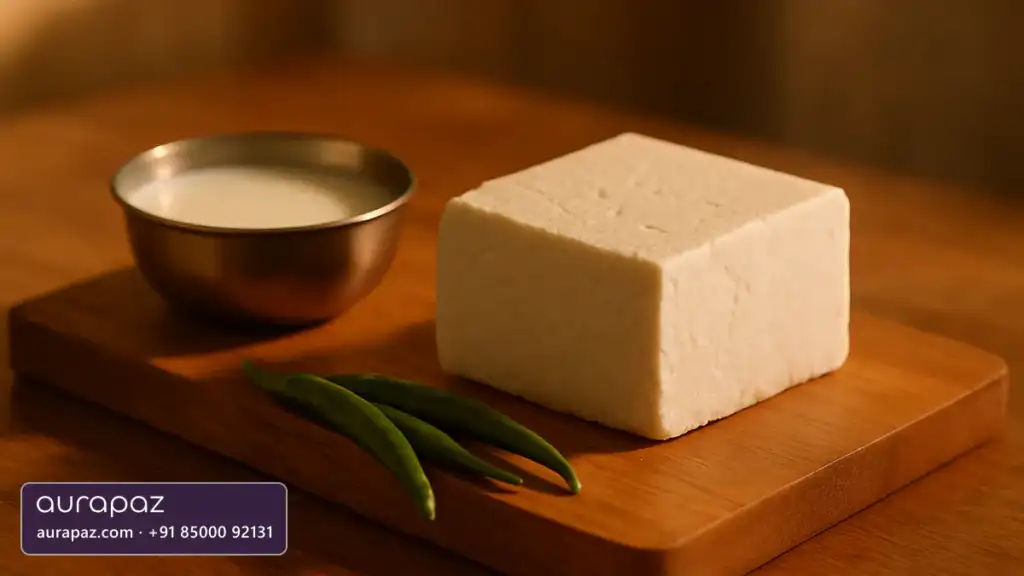
Real paneer has a legal identity in India, and it is specific. The standard defines it as the product obtained from cow or buffalo milk, precipitated with sour milk, lactic acid or citric acid, containing no more than 70 per cent moisture, with milk fat making up at least half the dry matter in the full fat grade. Added milk solids are permitted. Vegetable fat is not. That definition is why the regulator can act at all.
An analogue is what you get when you swap out the parts of a milk product that make it expensive. Replace the milk fat with vegetable oil, or the milk protein with a cheaper protein, add starch to hold the texture, and you have something that looks, cubes and behaves like paneer. Under Indian food law it is no longer paneer. It is an analogue, and the label has to own up to the substitution.
The usual substitute is refined palm oil, sometimes hydrogenated vegetable fat, plus starch. The result is a legitimate product category with a legitimate use. It is also, reportedly at around half the price of real paneer, an extremely tempting thing to relabel.
Myth versus reality: analogue and real dairy
| What the trend says | What the science says |
|---|---|
| Analogue paneer is fake food and it is illegal. | Under central law a properly declared analogue is legal to make and sell, but six states have banned or restricted it, so where you live decides. Selling it as paneer is never legal. FSSAI called that a grave violation in April 2026. |
| It is the same thing, just cheaper. | The parts removed are the parts you were buying. Milk fat and milk protein are replaced with vegetable fat and starch, so the protein and the milk micronutrients go with them. |
| It is packed with trans fat. | Overstated. Since January 2022 industrial trans fat has been capped at 2 per cent of total oils and fats in food products, so a compliant product is not a trans fat bomb. The catch is that compliance here is hard to police. The protein loss is the more reliable complaint. |
| You can spot it by taste. | Sometimes. Texture is a better clue than flavour, and a home iodine test for starch is better than both. FSSAI publishes the method. |
| Analogue and plant based are the same thing. | They are separate categories. Tofu and soy paneer are honestly sold as what they are. An analogue is designed to be indistinguishable from dairy. |
| If the restaurant does not mention it, it is real. | In FSSAI’s West Region, restaurants were told in April 2026 to declare analogue use on menus or display boards. Elsewhere that duty may not exist yet, so silence proves nothing. |

Analogue is not the same as adulterated
This is the distinction that most coverage collapses, and collapsing it leads people to the wrong worry.
There are three separate things on the shelf, and they call for three different reactions.
Real dairy. Milk in, paneer out, meeting a defined standard. This is what you think you are buying.
An analogue. Milk fat or milk protein replaced with vegetable fat, oil or protein. Under central law this is legal to make and sell, provided the label declares the substitution and nobody calls it paneer. Six states have since banned or restricted it regardless, so where you live decides. If you knowingly buy a declared analogue because it is cheaper, you have made an informed choice.
Adulterated or mislabelled food. An analogue sold to you as paneer. A restaurant serving it in a dish described as paneer. Or, at the ugly end, paneer bulked out with starch, detergent or worse. This is not a nutrition question, it is fraud, and in the worst cases a safety one.
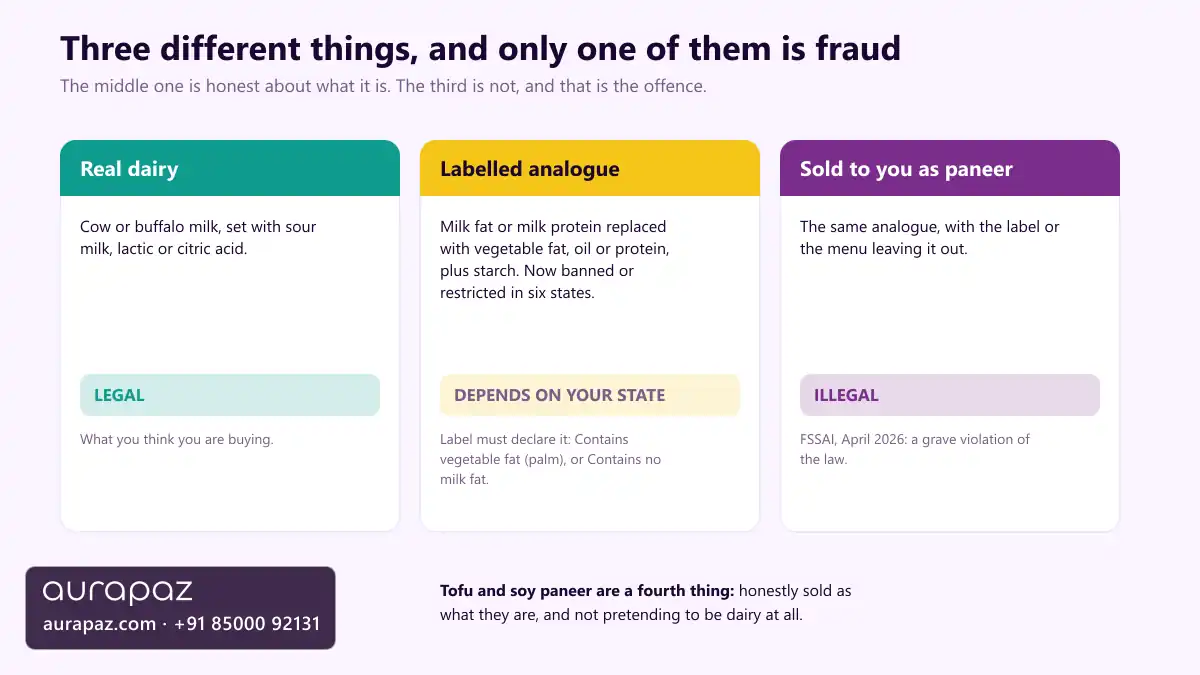
Keep those apart and the news makes sense. The notices are not aimed at a poisonous ingredient but at a product that is easy to pass off as something considerably dearer. The regulator’s own language gives it away: FSSAI’s April 2026 notice is about correct labelling, and it tells restaurant procurement teams and chefs to stop buying analogues under the name paneer.
What you actually lose
Now the part that matters at your table, and where I want to be precise rather than alarming.
Protein, which is the whole point of paneer
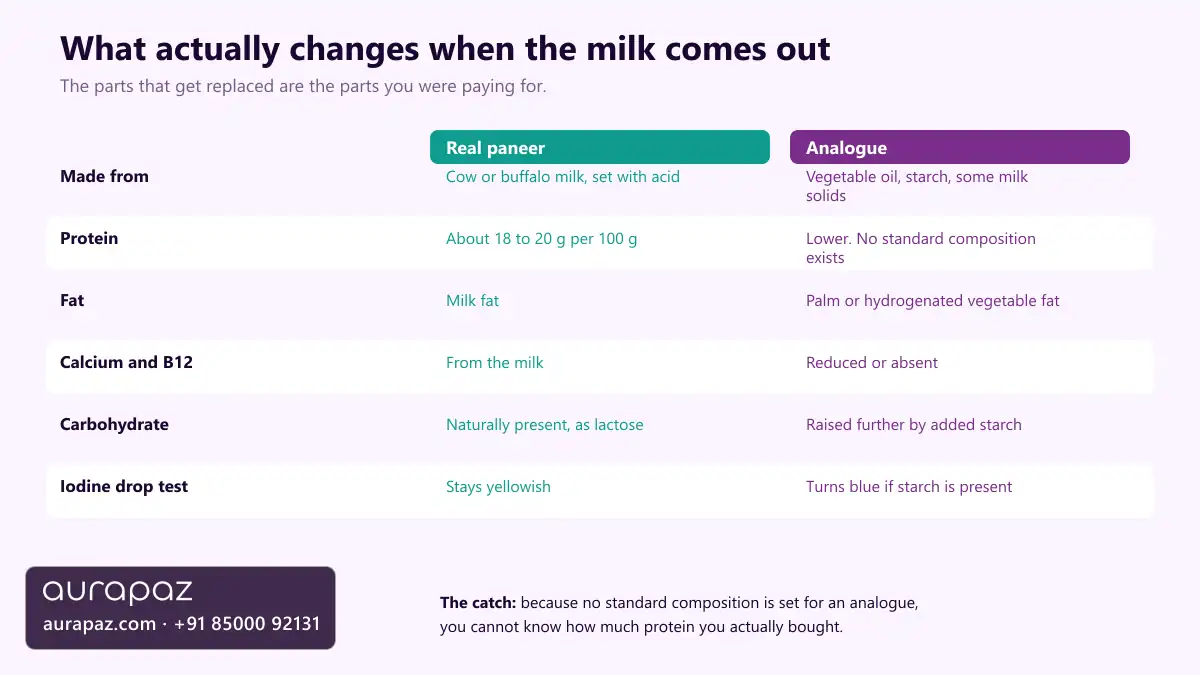
For a vegetarian household in India, paneer is not a treat. It is one of the few protein dense foods children reliably eat. Real paneer carries roughly 18 to 20 grams of complete protein per 100 grams.
Replace the milk protein with starch and vegetable fat and that number falls. By how much depends on the product, because no standard composition exists for an analogue, which is precisely what the NHRC has asked FSSAI to define. That uncertainty is the finding.
If you are feeding a growing child partly on paneer, this is the sentence that should worry you, not anything about palm oil. I have written before about how most Indian lunchboxes already fall short on protein, and about how much protein you actually need. Quietly cutting the protein in a staple undoes a lot of careful planning.
Calcium and B12, quietly
Milk products are a major calcium source in Indian vegetarian diets, and one of the few reliable dietary sources of vitamin B12 for people who do not eat meat, fish or eggs. Swap the milk components out and those come out too. Given how common B12 deficiency already is here, that is not a trivial loss. Our piece on B12 deficiency in Indian women covers why the baseline is already poor.
The fat swap, honestly assessed
Milk fat becomes palm oil or hydrogenated vegetable fat. I am not going to tell you milk fat is a health food or that palm oil is poison, because neither claim survives contact with the evidence, and I have made the case against the seed oil panic in our piece on seed oils.
What I will say is that the trans fat argument you keep reading is weaker than it looks. India capped industrial trans fat at 2 per cent of the total oils and fats in a food product from January 2022, the end point of a decade of stepping that limit down. A product that complies with that cap is not delivering the trans fat load the headlines imply.
I will not over-reassure you either, because compliance is what is in doubt. There is no prescribed test method for analogue paneer, one of the things the NHRC has asked FSSAI to fix, and a limit you cannot test against is thinner protection than it sounds. Trans fat is not the headline risk here. The protein loss is.
Starch, where there was none
Starch is added to hold the texture, which pushes the balance further towards carbohydrate and away from the protein you were buying. It is also the single most detectable difference, which turns out to be useful.
Why this became a national story in 2026
In April 2026, FSSAI’s West Region issued a public notice on the correct labelling of cheese analogues. The language was unusually direct: any cheese analogue sold as paneer is a grave violation of the law and must cease immediately. Manufacturers were told to name products unambiguously. Food service establishments were told to train their procurement teams and chefs, to watch incoming raw materials, and to disclose analogue use on menus or display boards. Officers were directed to carry out 100 per cent inspections of units making or using cheese analogues.
Then the states moved, and quickly. Maharashtra, Gujarat and Chhattisgarh banned analogue paneer first. In mid August 2026 Madhya Pradesh banned its production, sale and use, and Uttar Pradesh and Uttarakhand have banned it too. The scale explains the urgency: Madhya Pradesh officials described roughly 300 to 400 quintals entering the state daily, somewhere around 900 to 1,200 tonnes a month.
Days later the National Human Rights Commission stepped in, framing it around consumer deception. It asked FSSAI for the regulatory status of analogue paneer, its permissible composition, the nutritional implications, the possible health concerns and the prescribed testing methods. Chief secretaries were given two weeks to report inspections, samples collected, violations found and action taken.
Read the NHRC’s questions again. It is asking what analogue paneer is permitted to contain and how you would test for it. In 2026, those questions did not have settled answers.
It is not only paneer
Paneer got the headlines because everybody buys it, but the same logic runs across the dairy aisle, and some of it is harder to spot.
When Uttar Pradesh acted, it covered a list rather than a single product: analogue cheese and paneer, cream, ghee, chenna and khoya. That list is worth reading slowly, because of where those ingredients end up.
- Cheese analogue is the oldest and most widespread of the group, and the reason a pizza can be sold cheaply: it melts and stretches on demand. Sold honestly it is unremarkable. Sold as cheese, it is the paneer offence again.
- Analogue khoya and chenna matter most around festivals, because they feed straight into mithai. You are unlikely to be shown a label for the khoya inside a barfi, which makes the shop you buy from the entire quality control system.
- Analogue ghee is the one I would watch hardest. Ghee is bought specifically for being pure milk fat, at a price that reflects it, and a vegetable fat substitute defeats the entire purpose of the purchase.
- Analogue cream turns up in bakery and confectionery, where it holds up better in heat than dairy cream does.
None of these are inherently unsafe, and that needs separating from what actually triggered the Uttar Pradesh order. Inspectors there reported detergent, talcum powder, titanium dioxide, liquid glucose, hydrogen peroxide and neutralisers in milk and dairy products. That is not analogue dairy, it is poisoning, and it is already a crime. What the analogue products share is narrower: each is a place where you can pay a dairy price for a vegetable oil product without being told.
The objection worth taking seriously
The NHRC member leading this case, Priyank Kanoongo, made two points that cut against most of what I have argued, and they deserve an answer rather than a footnote.
First, he questioned whether a warning on a product actually stops it causing harm, comparing it to warnings on cigarettes. That is a fair hit on the labelling argument: disclosure only helps whoever reads the label, and the households most likely to be sold a cheap substitute are often least placed to interrogate one.
Second, he noted that analogue paneer may not be reliably caught by a starch based test, and that the testing mechanism needs strengthening. That is a fair hit on the iodine test below, which is why its caveat is written plainly rather than buried.
Where I part company is the word dangerous. The verifiable harms fall into two very different piles: a nutritional downgrade, real and worst for children, and adulteration with substances that were never food, already criminal. Calling a declared vegetable fat product dangerous blurs the two, and that is how you end up with families dropping paneer altogether. For Indian children’s protein intake, that would be the worse outcome.
How to tell, at the shop and at home
Practical, in order of how much they tell you.
The iodine test, which FSSAI itself publishes
The regulator runs a public programme called DART, short for Detect Adulteration with Rapid Test, designed for people to use in their own kitchens. The starch test for paneer is genuinely simple.
- Boil a small piece of the paneer in a little water, then let it cool.
- Add two or three drops of tincture of iodine, which any chemist sells.
- If the sample stays yellowish, no starch. If it turns a distinct blue, starch is present.
Real paneer has no reason to contain starch. A clear blue tells you something was added. Throw the tested piece away rather than eating it.
The test detects starch, not vegetable fat. A negative result is reassuring but not conclusive, and it does not distinguish a fully declared analogue from a fraudulent one. It is a useful screen, not a laboratory.
Texture, before taste
Real paneer crumbles: soft, slightly grainy, breaking rather than bending. An analogue tends to feel rubbery or faintly greasy, stretches instead of crumbling, and melts differently when heated. Flavour is a weaker signal than people assume, especially inside a spiced gravy.
The label, and what it is actually required to say
This is where most advice on this subject goes wrong. You are told to look for the word analogue. That word is not yet a legal requirement on a pack.
What the regulation in force requires is a declaration of the substitution, naming the constituent and its source. For each milk component replaced, the label must say so, in the form “Contains vegetable fat (palm)”. Where a milk component has been replaced entirely, it must say “Contains no milk fat”. The separate proposal to make brands prefix the words analogue or non dairy to the product name went out for public comment in April 2025 and has not been notified.
So read the small print instead of hunting for one word. A pack saying “Contains no milk fat” tells you what you need to know, even if analogue never appears on it. And a price far below everything around it is information: that discount comes from somewhere. Loose, unlabelled paneer from an unmarked tray tells you nothing at all, which is now a reason for caution rather than a neutral fact.
Ask the restaurant, out loud
This is the part people find awkward and it is the most effective. In FSSAI’s West Region, restaurants were told in April 2026 to declare analogue use on menus or display boards. Elsewhere in the country that duty may not exist yet, which makes asking more important rather than less. Is this real paneer or an analogue is a completely reasonable question, and a kitchen that cannot answer it has told you something.

What I tell families
Do not panic, and do not stop eating paneer. For a lot of vegetarian Indian families it is load bearing, and losing it means losing protein you were not replacing from anywhere else.
Buy from a source that labels what it sells, and prefer packaged over loose and anonymous while enforcement settles. Run the iodine test once on whatever you usually buy, out of curiosity rather than fear. Ask at restaurants. Treat a price that looks too good as information rather than luck.
The wider lesson is one this blog keeps arriving at from different directions. The further a food travels from its recognisable original form, the more room there is for something to be quietly substituted, which is the same argument as our piece on ultra processed foods. Milk set with acid is hard to fake. A white cube in a gravy is easy.
Key takeaways
- An analogue is a dairy product with the milk fat or milk protein replaced by vegetable fat, oil or protein. Selling it as paneer is never legal, and six states have now banned or restricted the product itself.
- On a pack, the rule in force is that the substitution must be declared, naming the substitute and its source, in the form “Contains vegetable fat (palm)” or “Contains no milk fat”. The analogue or non dairy prefix is still only a proposal, so its absence proves nothing.
- Keep three things separate: real dairy, a labelled analogue, and mislabelled or adulterated food. Only the third is fraud, and it is the actual problem here.
- The nutritional loss that matters is protein. Real paneer carries roughly 18 to 20 grams per 100 grams, and there is no standard composition for an analogue, so you cannot know what you are getting.
- Trans fat is not the headline risk. India capped industrial trans fat at 2 per cent of total oils and fats in food products from January 2022, though with no prescribed test for analogue paneer that cap is hard to police. The protein loss is the more reliable complaint.
- FSSAI’s April 2026 West Region notice called selling cheese analogue as paneer a grave violation and ordered 100 per cent inspections. The duty to declare it on menus applies in that region, not yet nationwide.
- Six states had banned or restricted analogue dairy by mid August 2026, Uttar Pradesh covering the widest product list, and the NHRC has asked FSSAI to define permissible composition and testing methods.
- It is not only paneer. Uttar Pradesh covered cheese and paneer, cream, ghee, chenna and khoya, and khoya feeds straight into festival mithai.
- Test at home with tincture of iodine. Blue means starch. It screens for starch only, not for vegetable fat.
References & Further Reading
- Press Information Bureau, Government of India. “FSSAI issues Public Notice on Correct Labelling of Cheese Analogues.” 22 April 2026 notice, FSSAI West Region. pib.gov.in.
- Food Safety and Standards Authority of India. “Detect Adulteration with Rapid Test (DART).” Household tests including detection of starch in milk products. eatrightindia.gov.in/dart.
- Food Safety and Standards Authority of India. Food Safety and Standards (Prohibition and Restrictions on Sales) Regulations: industrial trans fatty acids limited to 2 per cent by mass of total oils and fats in food products from 1 January 2022. Also sub-regulation 2.1.1 on analogue labelling, and the consultation paper on Analogue in Dairy Context dated 16 April 2025, under which the analogue or non dairy prefix remains a proposal. fssai.gov.in regulations.
- FSSAI consultation paper on Analogue in Dairy Context, 16 April 2025, which put the proposal to prefix dairy terms with analogue or non dairy out for public comment. No notification giving it legal force had been issued as at August 2026. Commentary.
- National Human Rights Commission action on analogue paneer, reported 14 August 2026: clarification sought from FSSAI on regulatory status, permissible composition, nutritional implications, health concerns and prescribed testing methods, with states asked to report enforcement data within two weeks. Report.
- Uttar Pradesh Food Safety and Drug Administration order on analogue dairy products, reported August 2026, covering analogue cheese and paneer, cream, ghee, chenna and khoya, and the adulterants reported in milk and dairy products during inspections. Report, and on the full product list, this list.
- Madhya Pradesh ban on the production, sale and use of analogue paneer, announced 13 August 2026, following Maharashtra, Gujarat and Chhattisgarh. Includes the remarks of NHRC member Priyank Kanoongo. Report.
- Indian Food Composition Tables 2017, National Institute of Nutrition, Indian Council of Medical Research, Hyderabad. Paneer (food code L003): protein 18.86 g per 100 g. IFCT 2017.